Creating an accurate digital twin of complex, operating heavy machinery requires specialized spatial solutions. For this project, we deployed advanced terrestrial and handheld 3D laser scanning—utilizing FARO Focus Laser Scanners—to capture an industrial ball mill with millimeter-level precision. Our methodology not only supports the data-driven frameworks championed by the Infrastructure NSW Digitalisation Program, but also aligns with the rigorous professional standards maintained by Engineers Australia, ensuring our deliverables provide the confidence necessary for precise reverse engineering and asset management.
The Challenge
Limited or outdated documentation for ageing plant equipment
Complex geometry across the ball mill and associated platforms
A requirement to minimise disruption to an operating site
Millimetre-level accuracy needed for the engineering design to follow
Restricted access around certain sections of the equipment
A need to model both large-scale infrastructure and smaller detailed components
Our Approach
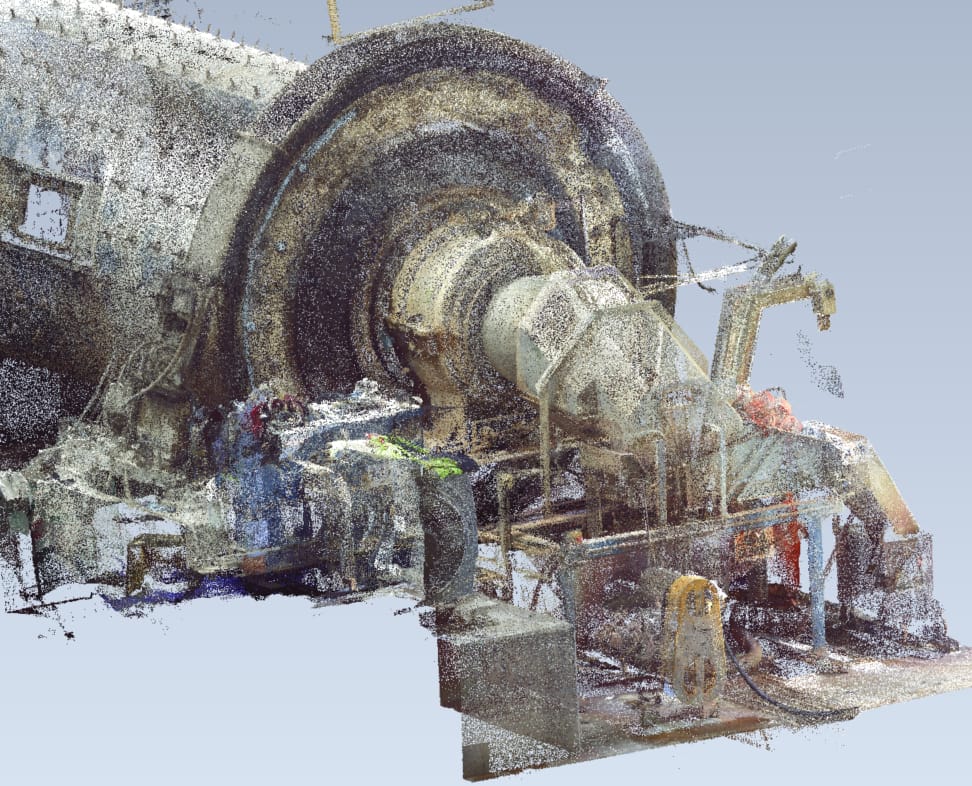
Terrestrial Laser Scanning: A high-accuracy scanner captured the complete ball mill room, including the shell, drive system, steelwork, and pipework. Multiple scans were registered into a single high-density point cloud to provide full spatial context.
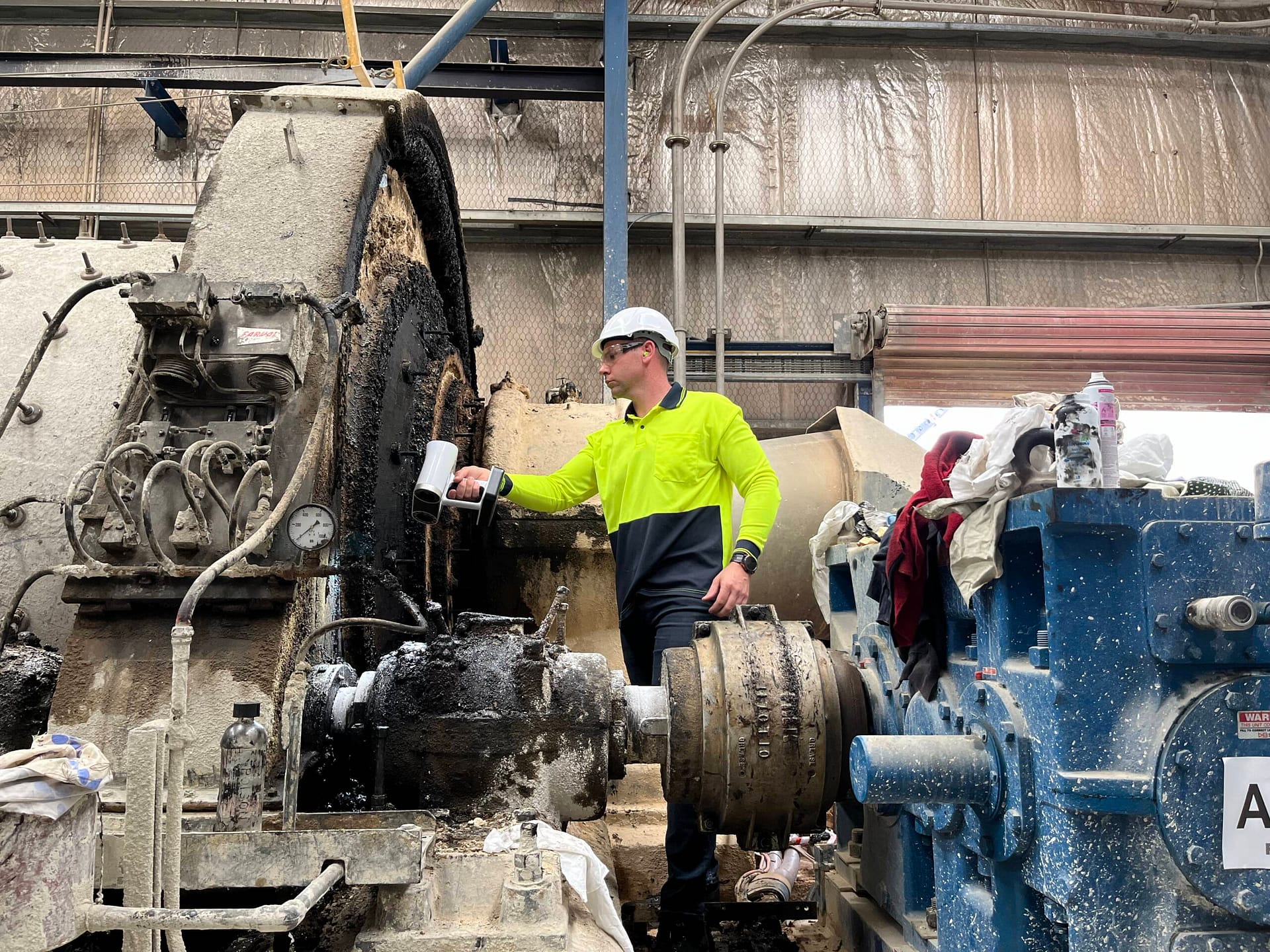
Handheld 3D Scanning: Areas requiring finer detail were captured with a handheld scanner. This enabled high-resolution capture of complex surfaces and precise dimensional verification where terrestrial data was insufficient.
Reliable dimensional data before any design work began, removing reliance on manual measurement
Engineers could design retrofit solutions directly against actual site conditions
Fewer site visits, with much of the review done remotely using the scan data
Future modifications could be checked against existing infrastructure before installation, catching clashes early
A permanent digital record of the installation for future maintenance and upgrades
Project Gallery
Surveyor operating 3D scanning equipment in an industrial setting to capture high-accuracy spatial data and point clouds for the Ball Mill digital twin project.
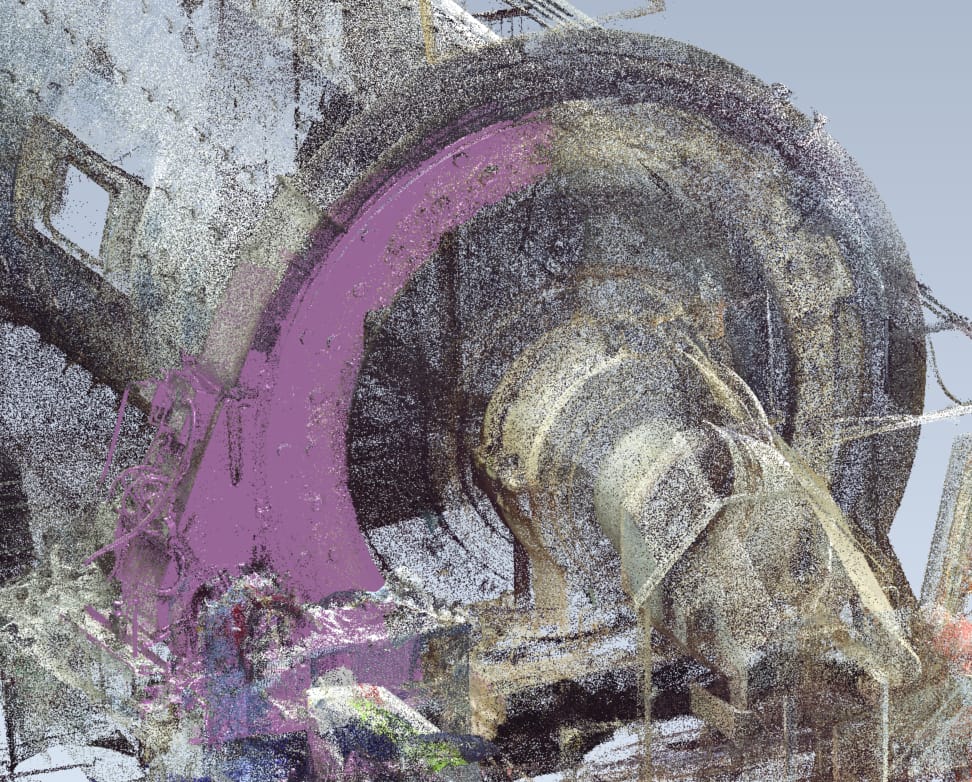
Detailed rendered mesh representation of specific ball mill components. Captured with an Artec Leo scanner, this close-up data provides the high-precision geometry required for accurate reverse engineering and equipment integration assessment.
Detailed point cloud representation of specific ball mill components. This close-up scan data provides the high precision required for accurate reverse engineering and equipment integration assessment.